Synthetic Data Sets empower data scientists to train financial AI models faster on more robust, highly-realistic, and PII-free data.
IBM
2023 - 2025
Won “Best AI Solution — Data Insights & Knowledge Management” at the FinTech Futures Banking Tech Awards USA
Scroll ↓
IBM Synthetic Data Sets are a family of virtually-generated, privacy-compliant data sets that catalyze the enterprise adoption of Large Language Models (LLMs), Generative AI, and Agentic AI by enabling faster access to rich data that businesses need for predictive financial solutions. Our team transformed what started as research idea into a fully-realized infrastructure product from 0→1.
Business impact
↑ Faster time-to-value
Increase in AI software and hardware (Spyre) POCs across IBM Z, Partner Ecosystem, and Global Sales accounts by providing data that sped up the overall AI model lifecycle process, illustrating product value to customers within weeks rather than months.
User impact
↑ Faster data pre-processing
Data scientists went from spending 6+ months to spending less than 2 weeks on data pre-processing because of the pre-labeled and pre-balanced data, some getting started on AI model training immediately after downloading the data sets.
Contribution
Design Lead
I led the design strategy, research, and visual design for end-to-end user experiences spanning the AI model lifecycle with a focus on product knowledge and data pre-processing. I grew a breadth of skills in partner ecosystem sales plays, pricing, versioning, Data-aaS, and agent-based modeling techniques.

Digital twin isometric illustration, IBM Blue Studio
IBM Blue Studio
describe exactly what is SDS
3 types of data sets
use cases (building, enhancing, validating)
impact (F1 score)
Note: IBM Synthetic Data Sets are built from a virtual world with virtual people buying from virtual businesses transacting through virtual financial institutions who sometimes deal with virtual fraudsters, money-launderers, or natural disasters. This method is called Agent Based Modeling, where complex systems (society) are simulated by representing collections of autonomous, interacting entities called “agents” (people) that follow predefined rules and interact with their environment (transactions, banking, fraud). The rules of our virtual world are determined by statistical distributions from the publicly-available anonymized data sources: population statistics (i.e. US Census), company 10k data, national weather data (i.e. National Oceanic Atmospheric Administration), and federal reserve data.
My contribution
Emerging technology is inherently uncertain because customer needs, product direction, and commercialization all evolve at the same time. As the Design Lead for a small but mighty team, I worked across research, design, and strategy — allowing me to connect those decisions instead of treating them as separate work streams.
Impact [redundant, could remove and underline, can we talk about how we stretched role here or later?)
Customer research informed product strategy, product strategy shaped the user experience, and the user experience became the foundation for sales and marketing. This reduced uncertainty throughout development and helped bring a technically complex AI product to market with greater clarity and confidence.
Researcher
How did we get here?
Through customer interviews, ecosystem research, and market validation, I uncovered unmet needs across enterprise customers, ISVs, MSPs, and partner organizations. These insights shaped customer segmentation, informed product direction, and revealed commercialization opportunities that extended beyond the initial product vision.
Designer
Where are we going?
I translated complex technical concepts into clear, usable experiences for both technical and business audiences. This included visualizing the AI model lifecycle, designing product narratives and educational assets, creating user journey frameworks, and developing launch-ready marketing materials that made synthetic data approachable and actionable. By reducing cognitive complexity, the work accelerated customer understanding and internal alignment.
Strategist
What do we build first?
I partnered across product management, engineering, research, sales, and marketing to define pricing and packaging approaches, partner ecosystem plays, versioning strategy, Data-as-a-Service opportunities, and commercialization plans. My role was to connect technical innovation with market demand, ensuring the product solved the right problem while creating a viable path to launch.
Research-centered strategy
I built the research infrastructure for a 0→1 enterprise product by creating repeatable systems that transformed internal assumptions and ad hoc client conversations into a scalable product discovery practice.
Assumptions and Questions
Before engaging customers, I introduced an assumptions and questions exercise to create a shared source of truth, expose knowledge gaps, and translate broad uncertainty into a prioritized research plan to address product, market, and user needs. Rather than conducting exploratory interviews without direction, every customer engagement was primed to test specific hypotheses.
The critical unknowns that required direct user input were categorized in two key buckets:
PRODUCT USAGE
How realistic is synthetic data compared to real data (i.e. fraud percentage, same or better F1 score)?
What information does IBM Synthetic Data Sets offer that is impossible to get from real data or other artificial data?
COMMERCIALIZATION
Which value propositions and differentiators resonate most with enterprise buyers?
What technical evidence and proof points are required to establish trust and justify adoption?
Engagement funnel
Working with a new enterprise data product meant there was no established customer discovery process. I introduced a structured engagement pipeline that organized research, and enabled the team to validate assumptions, build institutional knowledge, and make roadmap decisions from cumulative customer evidence rather than isolated conversations. The framework has been adopted across the broader portfolio as a standard practice.
01
Prospecting
Real data includes Personally Identifiable Information (PII) that is non-compliant to use.
02
Recruitment
Real data is time-consuming and costly to access, taking up to 6 months to retrieve.
03
Engagement
Real data cleaning, labeling, and balancing is complex and use-case specific.
04
Usage
Customers’ real data misses user behaviors and market segments from other companies.
Research metrics (how to make final numbers bigger)
43 Engagements
1:1 Interviews
Focus groups
Events
38 Hours of engagement
Across 3 quarters
28 Unique clients
Financial Services
Insurance
Banking
Technology
Government
271 Observations
70 Positive product feedback
96 Product recommendations
123 As-is AI workflows
54 Pain points with real data
27 Constructive product feedback
Key learnings from customer engagements
Data scientists are responsible for building, enhancing, and validating AI models, while AI Executives are responsible for the overall delivery of customer-centric AI solutions — but using real data introduces access and compliance restraints that make it difficult to develop competitive AI solutions quickly and efficiently for both users.
People are the lifeblood of product

Data Scientist
End User
NEEDS STATEMENT
needs statement
PAIN POINTS
Restricted data access
Real data is time-consuming and costly to access, taking up to 6 months to retrieve.
Long data pre-processing times
Real data cleaning, labeling, and balancing is complex and use-case specific.
OPPORTUNITY
Opportunity statement (include f1 score to tie back to end)

AI Executive
Decision Maker
NEEDS STATEMENT
needs statement
PAIN POINTS
Data privacy constraints
Real data includes Personally Identifiable Information (PII) that is non-compliant to use for product development.
Limited scope of user behavior
Customers’ real data leaves out user behaviors and market segments from other companies.
OPPORTUNITY
Opportunity statement
As-is journey for different customer segments
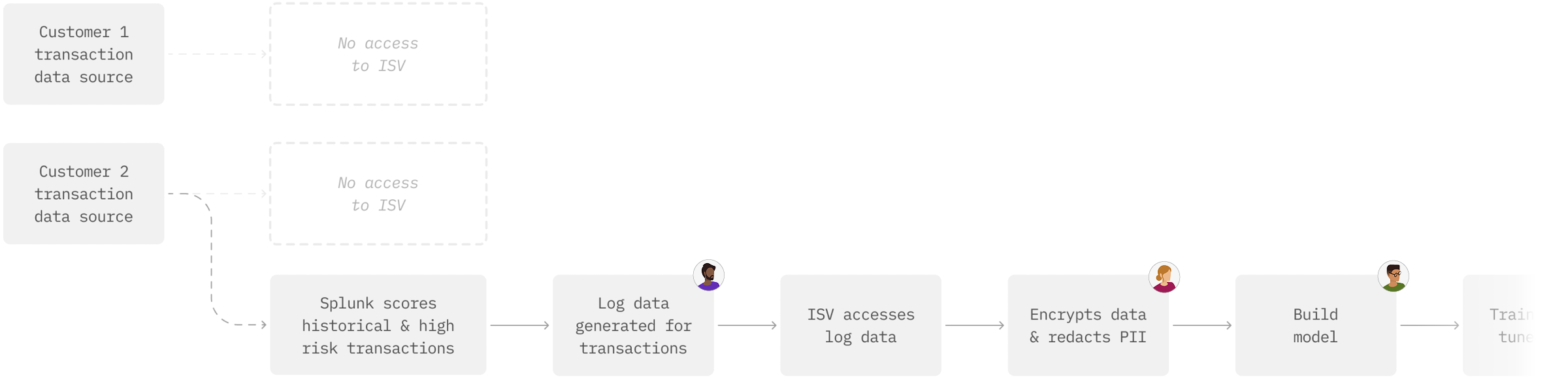
Through consistent research with individual enterprise customers and our partner ecosystem, we uncovered that customer value wasn't evenly distributed across the market. While both enterprise customers and ISVs recognized the potential of synthetic data, ISVs faced a fundamentally different constraint: they lacked direct access to the rich, holistic customer data needed to build AI solutions. This insight shifted our go-to-market strategy toward the segment with the strongest product-market fit for our initial release.
INDEPENDENT SOFTWARE VENDORS (ISV) and MANAGED SERVICE PROVIDERS (MSP)
(Target for initial release)
CAN WE KEEP THIS SHORT AND IMPACTFUL, CAN YOU ALSO INCLUDE CONTEXT ON WHAT THESE CUSTOMERS DO AND WHY THEY HAVE DATA CONSTRAINTS) ADD QUOTE
ISVs and MSPs were constrained by privacy and compliance requirements that prevented direct access to customer data, forcing them to rely on logs and system events as proxies for user behavior. This distinction revealed where Synthetic Data Sets delivered the greatest value and shaped the target customer, product positioning, and go-to-market strategy for the initial launch.
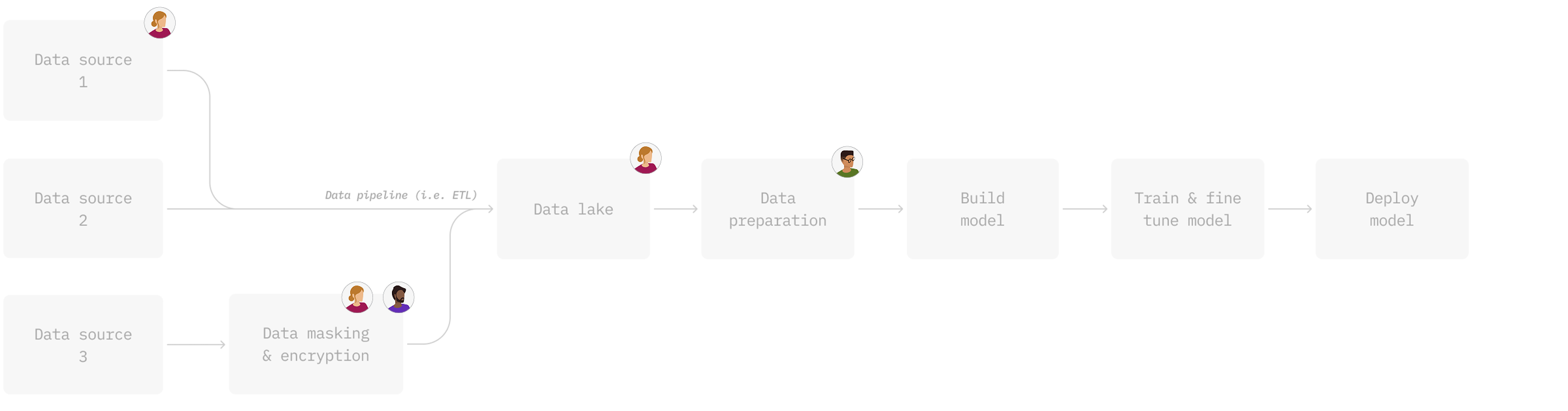
INDIVIDUAL ENTERPRISE CUSTOMERS
(Target for future releases)
While enterprise customers already had access to their own proprietary datasets which lacked diversity and pre-balancing, synthetic data was seen as a complementary input to existing workflows.
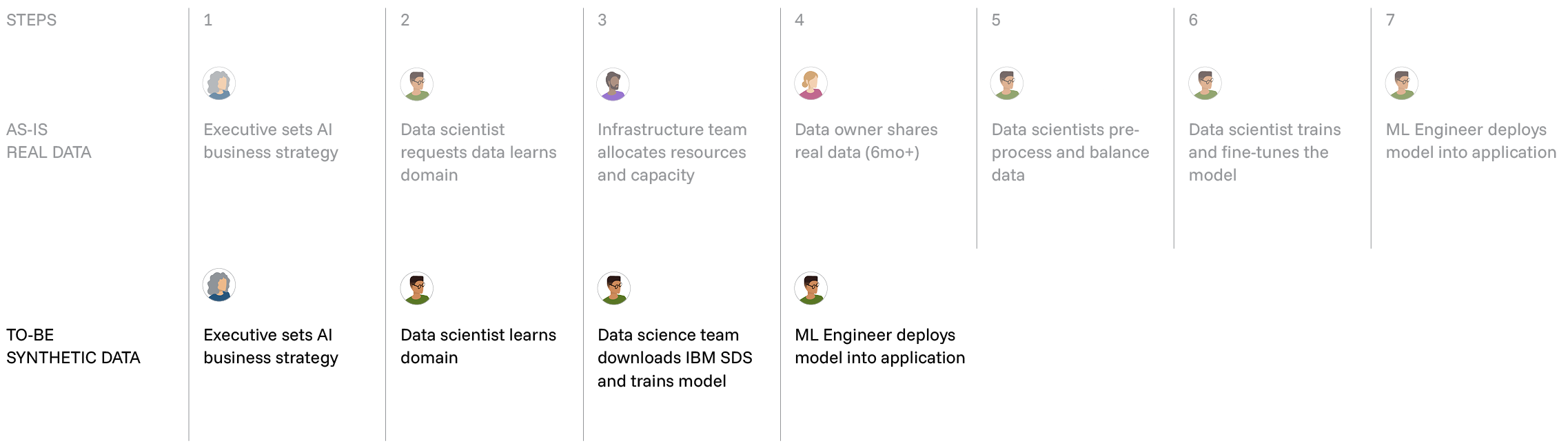
To-be journey in the context of end-to-end AI model lifecycle (need to make more clear that each graphic is for customer and internal selling teams)
Both customer segments understood the challenges of working with real-world data but struggled to conceptualize how synthetic data really contributed to faster business outcomes. After synthesizing various as-is data journey maps, I created this end-to-end AI lifecycle to visualize how IBM Synthetic Data Sets simplifies the path from strategy to deployment by eliminating data acquisition bottlenecks, reducing preprocessing, and enabling immediate model training.
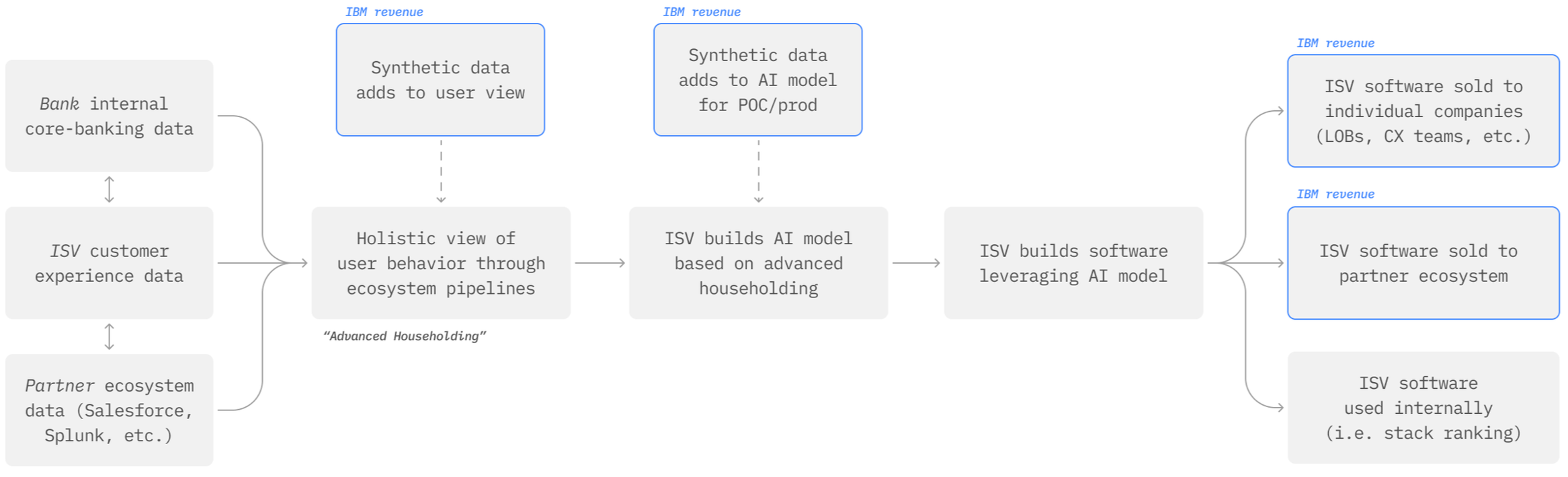
Key insight $$$ for revenue opportunities upon initial release (SHORT AND CLEAR THAT ISV NEEDS AND ENTERPRISE CUSTOMER SELLING PATH WAS A NEW CUSTOMER SEGMENT, HOW DID I CONTRIBUTE SPECIFICALLY)
After identifying ISVs and MSPs as the strongest initial market for Synthetic Data Sets, I explored how these insights could extend beyond our primary customer segment. In the spirit of continuous product discovery, I brought customer research back to IBM’s Partner Ecosystem, who similarly expressed a need develop AI-powered products and services enriched with Synthetic Data Sets — ultimately to bridging the needs of (1) ISVs/MSPs who had no holistic data access and (2) individual enterprise customers who had no data diversity.
The diagram gave stakeholders a shared vision for how we planned to execute our initial release connecting internal and external user insights directly to an ecosystem selling strategy.
“Add in 1-3 quotes highlighting the pain points above
Quote source
Quote source details
Go-to-market
By blending product discovery with commercialization research, I helped define both the product experience and the go-to-market narrative — identifying differentiators and supporting evidence that would increase customer adoption by Data Scientists and buy-in from AI Executives.
Data comparisons
Research quickly revealed that customers struggled to distinguish synthetic data from anonymized, artificial, and real-world data. Rather than presenting technical features in isolation, I reframed customer insights into a comparison framework that clarified IBM's competitive advantage, addressed common misconceptions, and equipped both product and go-to-market teams with a shared narrative for conversations with Data Scientists (end users) and AI Executives (decision makers). reduce graphic text, and also highlight first sentence in this paragraph.
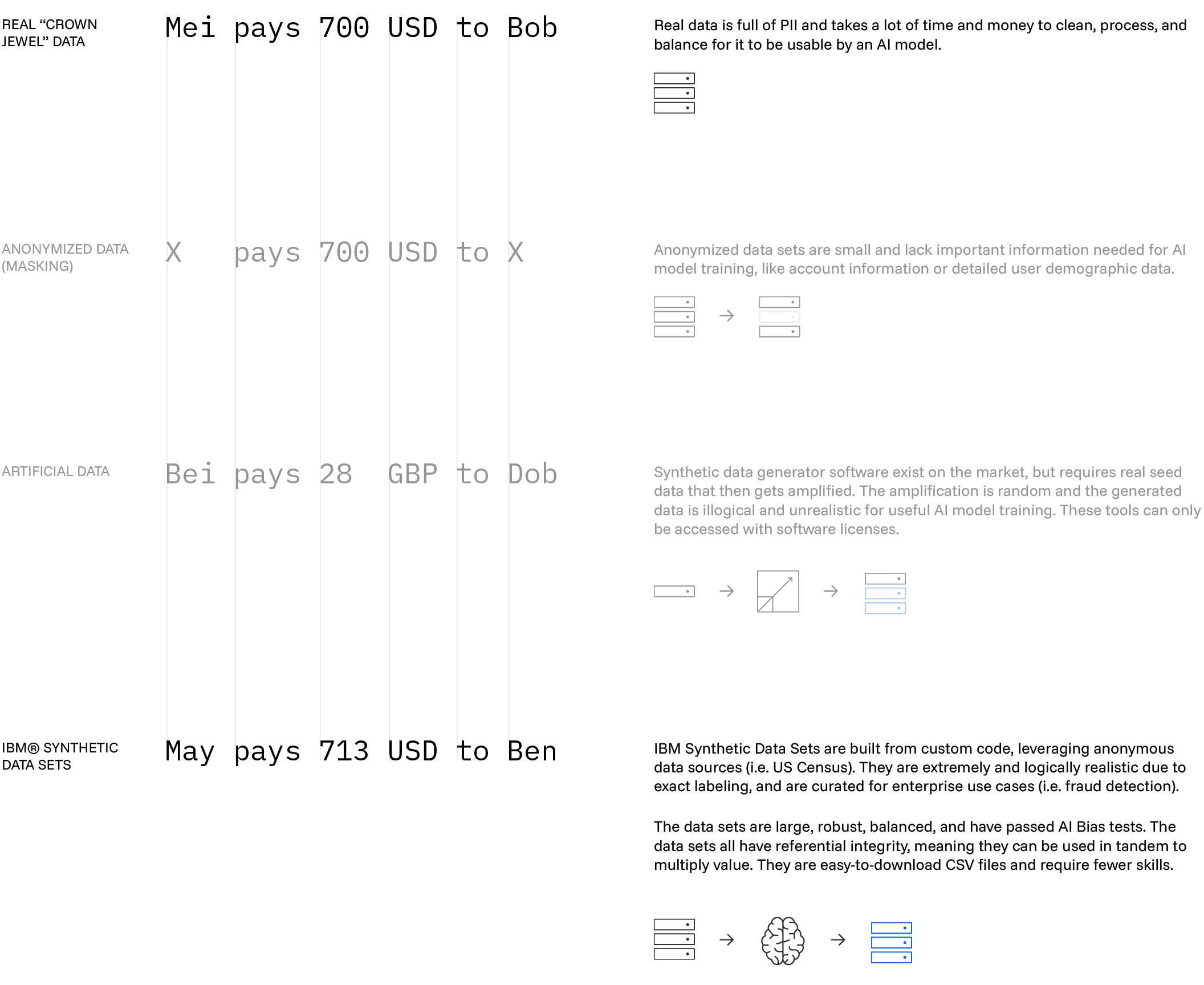
Visualizing the value propositions (more clearly tie back to how this addressed questions and assumptions, and show marketing assets more clearly — does this still apply to the roles at the top?)
CONSIDER REMOVING - WHAT IS BEING SHOWN, DEPTH AND BREADTH OR TECHNICAL?
Through mixed-method research, I synthesized the unique needs of our two target users (Data Scientists and AI Executives) and translated those insights into a set of research-backed messaging pillars that gave product, marketing, and sales teams a shared language for explaining the value of Synthetic Data Sets. Below are snippets of the the resulting artifacts that helped transform technical capabilities into customer-centered proof points that scaled across the following go-to-market channels:
Product page
Sales enablement
Social media marketing
Webinars
Blogs (IBM and third-party)
Eminence opportunities
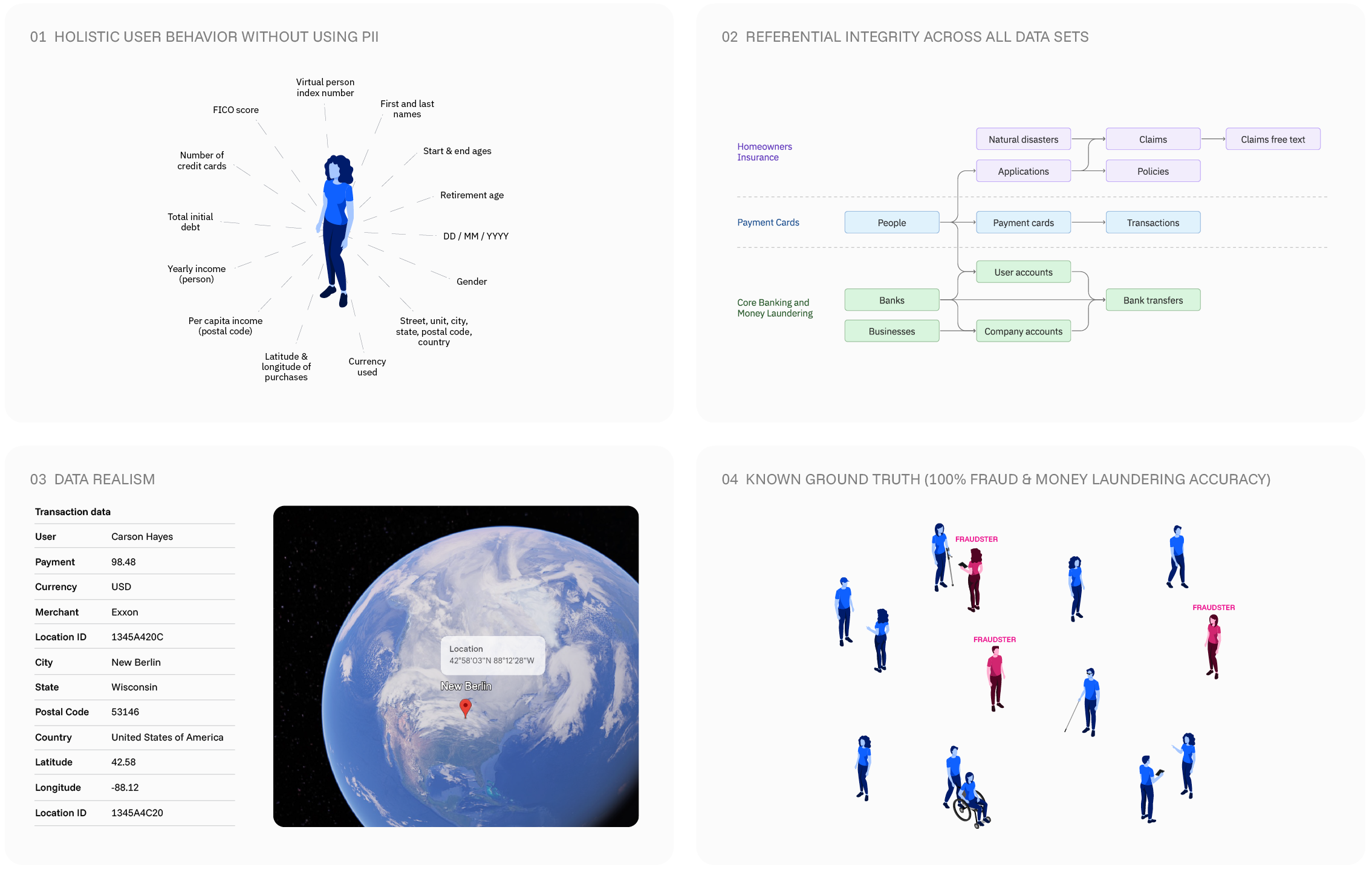
Product readiness for initial release
The role of design in responsible AI and data governance
As the Design Lead (CHANGE ALL DESIGNER TO DESIGN LEAD), I led with the ethos that fairness and positive user experiences are tightly linked. Throughout the project, my goal was to reduce uncertainty between those two concepts for Data Scientists who were tasked with creating responsible AI solutions with synthetic data. By incorporating bias indicators and fairness reviews into the release process, our team refined the datasets, and successfully passed IBM's AI Fairness 360 assessment, ensuring the product was not only useful, but trustworthy for enterprise deployment.
Bias indication formula: 1 + 2 = 3
1
Features of an individual
Sensitive feature
Age
Sex
Race
Socioeconomic status
Disability
Insensitive feature
Postal code (racial segregation)
Hair color (hair related to race/age)
2
Majority or Minority classification
Is the individual part of a majority or minority based on their feature (i.e. in certain postal codes
3
Favorable vs unfavorable outcome
What type of outcome is achieved based on their feature and majority/minority segment
Individual vs group fairness
Group fairness means everyone in group should be treated the same
Individual fairness means similar people should be treated the same, but not all people
Eminence
IBM Synthetic Data Sets won “Best AI Solution — Data Insights and Knowledge Management” at the Banking Tech Awards 2025 hosted by Fintech Futures
Launching a 0→1 enterprise product isn't just about building the right solution, it's about building trust in an entirely new category. Throughout the project, I approached design as a tool for commercialization, helping translate complex technology into a clear product narrative that customers and industry experts could understand and believe.
That strategy extended beyond research and product design to include external validation through industry recognition. Our work was featured across IBM thought leadership, external publications, and competed alongside established global financial institutions. Our small multidisciplinary team demonstrated that thoughtful product strategy, research-driven storytelling, and clear customer positioning could earn credibility for an emerging technology. For me, the award represented more than recognition — it validated that trust can be intentionally designed and that research, product, marketing, and design together can accelerate market adoption.
Positive customer feedback
“This is exactly what we were looking for — it’s the missing piece of the puzzle to jumpstart an end-to-end advanced householding solution for our banking clients.”
OVATION CXM
Banking Customer Experience Orchestration
“IBM Synthetic Data Sets is great because it provides an end-to-end view of a transaction, and we have an appetite to be proactive about pre-trained risk identification by looking at holistic user behavior.”
PROMONTORY NETHERLANDS
Michael Cooney
Future releases
To shape the next generation of IBM Synthetic Data Sets, I initiated a new phase of generative research as a part of our continuous discovery process. The outcomes combined customer feedback with outstanding assumptions from our initial discovery work.
01 Additional schemas
RESEARCH OBJECTIVE
What changes do we anticipate customers might need in future versions of our data sets?
INSIGHT
Customers are interested in adding anonymous, user-driven, unstructured data to augment the “perfect” synthetic data created by Agent Based Modeling. Our team will prioritize adding schemas and data that are aligned to our AI business growth strategy (Traditional AI, LLMs, Generative AI, Agentic AI).
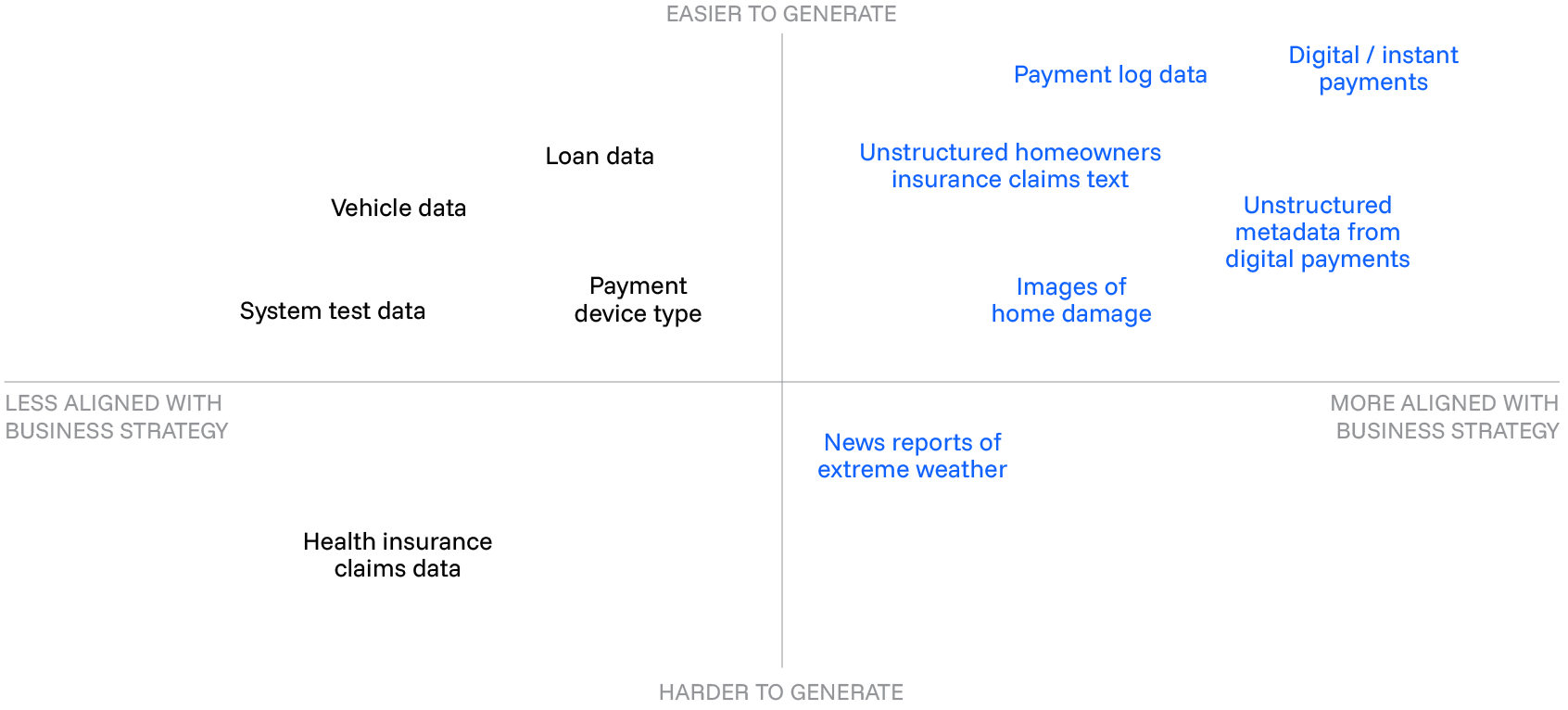
02 Data-as-a-Service
RESEARCH OBJECTIVE
How might we enable customers to autonomously customize data as they scale their AI needs?
INSIGHT
Customers will benefit from a Data-aaS user experience where they can generate data based on customized parameters, while maintaining the quality offered in IBM Synthetic Data Sets (known ground truth, data realism, referential integrity, rich attributes), through an intuitive interface and easy download.

01
GENERATE NET NEW DATA FROM IN-HOUSE SEED DATA
Pros
More personalized data variation outside of IBM SDS master data set
Competitive similarity to data generators
Cons
Potential user expectation to incorporate their real data as seed, compromising the original benefit
More development and design resources needed for prototyping and feedback

02
SUBSET ENTIRE SYNTHETIC DATA SETS BASED ON NEEDS
Pros
User can download any size of data set
User can “build their own” data set with various schemas relevant to their specific use case
Cons
Less user customization with their own seed data
Unclear how updates to the master data set would affect user generated data over time
Reflection
This project reinforced my belief that design is a powerful tool to reduce uncertainty through interrogation and iteration. I empowered our team achieve less uncertainty, which meant more trust — a concept applied to both how I worked with my team as well as how I served our users.
Alignment and repeatable processes
Trust in our ways of working
Product positioning
Trust that this product is differentiated
User discovery
Trust that we're solving the right problem
Industry recognition
Trust from the market
Commercialization
Trust that customers understand the value
Responsible AI
Trust in the product itself
More information
Eminence
IBM Community Blog
IBM targets mainframe customers with prebuilt AI training modules
Network World
Online recognition
Source
Archival research science
Insert link
Insert source
Erik Altman
Insert link
Insert source
Erik Altman
Insert link
Insert source
Erik Altman